

Inside Education Freedom – Edition 6 – 9 February 2026
A regular update from the Pestalozzi Trust on legal, policy, and advocacy developments affecting home education in South Africa.
It is now one year since the BELA Act imposed a registration deadline for existing home schoolers. Parents who were already homeschooling were told that they had until 23 January 2025 to register, and 23 January 2026 marked twelve months since that cut-off date. A full year is long enough to judge whether the education departments can do what the law requires: receive applications, process them within the legal timeframe, and issue certificates.
The Pestalozzi Trust, its members, and other homeschoolers warned that the BELA Act did not cater for homeschooling, that research was needed before implementation, and that the system would not be workable in practice.
A year later they have been proved right. The BELA Act is broken.
Leaving aside the major controversial issues such as assessment that is “against a standard that is not inferior to the standard determined in the National Curriculum Statement” it is the basic issues that are still problematic.
A Basic Administrative Roadblock
After a year, the Department of Basic Education (DBE) still cannot say how many homeschoolers there are in South Africa. This means they can’t assess, even on the most basic level, if the Bill is achieving its objectives. Thousands of home schoolers have registered leading up to the 23 January 2025, and since then, but is that percentage 60%, 80% or 90% of all homeschoolers?
Irrespective what the percentage of homeschoolers that have applied is, the provincial education departments can’t issue certificates on time. The Pestalozzi Trust undertook a nationwide registration survey from 27 July 2025 to 27 November 2025. Only about 20% of the thousands who applied have received their certificates, as the extracts of the survey results below show.
Home Education Registration South Africa – 2025 Survey
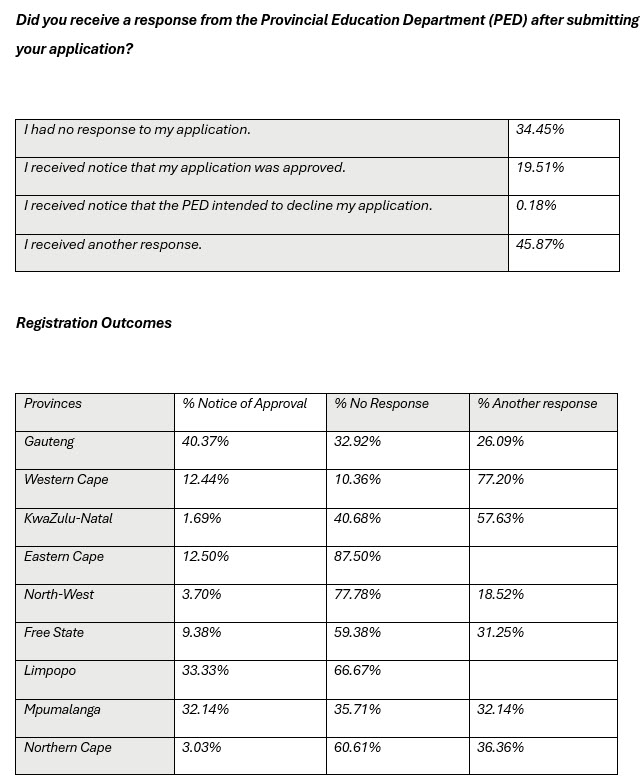
Your chances of getting a certificate therefore seem to depend on which province you are in. Gauteng stands out for a higher reported approval rate of 40.37%, but a third of applicants still reported no response
The Western Cape shows a very high rate of at least some form of response at 77.20%. In the Western Cape, the WCED later began a more intensive registration drive, issuing certificates after 60 days and the number of certificates issued there has increased since the research was completed.
KwaZulu-Natal’s figures are stark, with only 1.69% reporting an approval notice and 40.68% reporting no response, suggesting that applications are basically ignored.
In the Eastern Cape and North West, the reported “no response” rates are extremely high, which supports what families report in practice: applications disappear into a process that does not end in a certificate within any predictable period. This highlights the wider problem: in most provinces, the 60-day legal timeframe is not treated as a deadline.
Assessments and Notifications?
The administrative failure has practical consequences.
The BELA Act requires homeschoolers to submit end-of-phase assessments and end-of-phase notifications. However, provincial education departments have still not issued certificates and registration numbers to most applicants.
Even if one sets aside, for the moment, that no one has been told what those assessments must look like, the system does not work when only about one in five families has a certificate and a registration number to link a notification or assessment to when they send the document in, to say nothing of how the provincial education department can file it.
This part DOES work: “Deemed approved after 60 days”
There is one protection in the law that is clear.
After 60 days have passed, if a parent has proof that an application was submitted, the child is deemed registered, and the protections against arbitrary cancellation in the BELA Act apply.
This is the part of the Act that functions as a legal safeguard, even where administration has failed.
BELA is Broken
One year after the 23 January 2025 registration deadline, the results are clear. A deadline was imposed on home schooling families, but in many provinces the state has not met its own legal timeframe to process applications and issue certificates, and the survey results show that outcomes depend heavily on where a child lives.
Where the 60-day period is treated as optional, the registration system cannot serve as a workable foundation for further compliance steps such as assessments and notifications, because most applicants still lack the certificate and registration number that the system presupposes.
Inside Education Freedom is published by the Pestalozzi Trust, defending home schooling in South Africa since 1998.