
Inside Education Freedom: Edition 4 – 3 October 2025. A regular update from the Pestalozzi Trust on legal, policy, and advocacy developments affecting home education in South Africa.
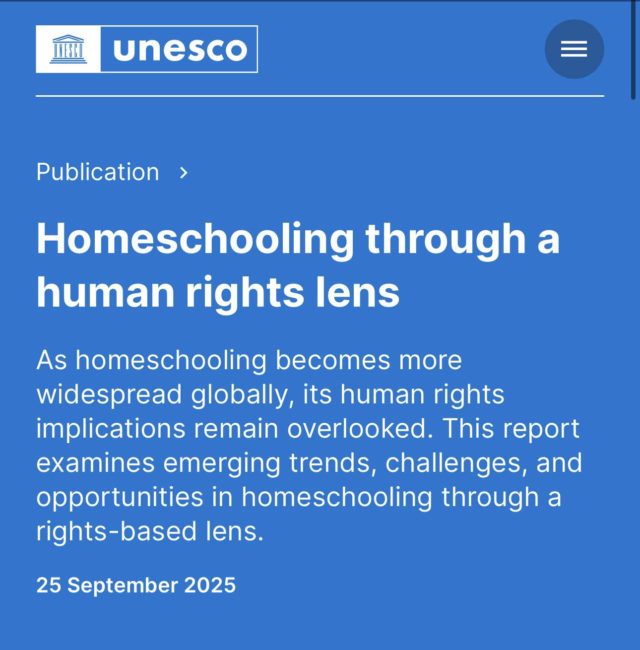
On 25 September 2025 UNESCO released its first major report on homeschooling, entitled Homeschooling through a Human Rights Lens.
This marks the first time that homeschooling has been examined at the international level in such depth, and it is therefore an important document. These reports are not binding in law, but they reflect and shape global attitudes towards homeschooling and will influence future debates in South Africa and on the global stage.
Recognition of Parental Rights
A central feature of the report is its recognition of parental rights. The report affirms that parents and legal guardians have the right to choose the kind of education their children will receive, echoing long-standing human rights instruments such as the Convention against Discrimination in Education and the International Covenant on Civil and Political Rights.
The report also places children’s rights within this framework, stating that children’s voices should be heard, but always in the context of parental decision-making.
The report reflects the international law position that states can impose “minimum standards.” It is mentioned that in South African we have freedom of curriculum choice. We must fight to ensure that these minimum standards do not infringe on the freedom of curriculum choice.
Placing the child’s right to education within the context of the parent’s right to choose is a positive development.
Why These Reports Matter
It is important to note that UN reports of this kind are not treaties. They do not bind states in the way that formal international agreements do. Indeed, current political realities mean that new binding treaties on education are unlikey.
Nevertheless, these reports are highly significant because they shape how governments, civil society, and academics think about issues. Where certain approaches become widely accepted in international policy discussions, they quickly filter into national debates and can become the assumed norm. This means such reports must be read with care. Positive affirmations of rights must be acknowledged and built upon, but where concerns or proposed measures threaten parental authority or family autonomy, they must be contested.
Key Homeschooling Voices
It is encouraging that voices from the homeschooling community played a prominent role. The Trust is proud that Mike Donnelly, a member of our Advisory Council, was one of the experts consulted. Other friends and colleagues, such as Ignasi Grau of OIDEL (the Trust is a member organisation of OIDEL) and Alexandre Moreira, co-drafter of the Rio Principles on Home Education, also made contributions. Their involvement ensured that parental rights were not overlooked in the drafting process.
South African academics, particularly those connected to the Abidjan Principles, played a prominent role. The Abidjan Principles favour a strongly state-centred model of education and emphasise regulation of non-state provisioning. Their influence is visible in the repeated references to oversight mechanisms such as registration, evaluation, and even inspection.
Key Themes and Areas of Concern
1. Parental Freedom
The report acknowledges that parents have the right to direct their children’s education, but it also links this right to the state’s ability to set minimum standards.
2. Oversight and Home Visits
The report mentions inspections and home visits as ways to monitor homeschooling.
In South Africa, we can be very grateful this was removed from the BELA Act: home visits are not permitted in our law. Families must remain vigilant to ensure that this hard-won protection is not eroded in future policy debates. The Trust, therefore, urges all parents, whether members or not, to resist even voluntary home visits.
3. Comprehensive Sexuality Education (CSE)
The report promotes CSE and questions if home schoolers are receiving sufficient education in this area. In South Africa, officials have already stated that families who reject CSE should place their children in independent schools or homeschool them. This is, therefore, not an immediate threat for homeschoolers in South Africa. We must, however, vigorously challenge any promotion of state-determined sex education in home schooling.
4. Socialisation
The report repeats the longstanding claim that homeschooling may limit socialisation. The report also notes that socialisation may not be lacking. It seems that it is difficult to prove the level of socialisation that most home schoolers enjoy to policymakers who have a naïve belief in the positive benefits of socialisation in schools. We know that schools do socialise well but that it is often negative socialisation. A fundamental shift in outlook is needed.
It is worth noting, however, that the report also acknowledges that when parents homeschool, they often remove some of the most capable and engaged families from the conventional schooling system. This observation inadvertently recognises the strength of the homeschooling community, even while framing it as a concern for schools.
5. International Differences
The report reviews legal approaches worldwide. In England and Wales, notification is treated as equivalent to registration, which is less intrusive than South Africa’s current model. In Germany, by contrast, homeschooling remains illegal. These contrasts show the wide latitude states have and underscore the importance of defending South Africa’s space for homeschooling.
Reading the Report Carefully
Read the report here: https://unesdoc.unesco.org/ark:/48223/pf0000395671
UN documents are the products of committees, and as such they reflect compromise. Statements that affirm rights are usually consensus positions that few dispute, in this case the parental right to choose. By contrast, areas labelled as “concerns” often indicate the real divisions. For home schoolers, these are the points that require the most scrutiny and resistance when the impact our rights.
Looking Ahead
The UN report will not change South African law. But it will influence policy debates in the Department of Basic Education, in Parliament, and in academic circles in the future. The positive points such as the strong statement on the right to choose and the statements that freedom of curriculum choice exists in SA are important aspects to build on. It is crucial for the homeschooling community to engage critically with such reports: to reinforce the affirmations of parental rights and to oppose measures that expand state control.
The Pestalozzi Trust will continue to work with international partners and local families to defend the principle that education belongs first to families, not to the state.